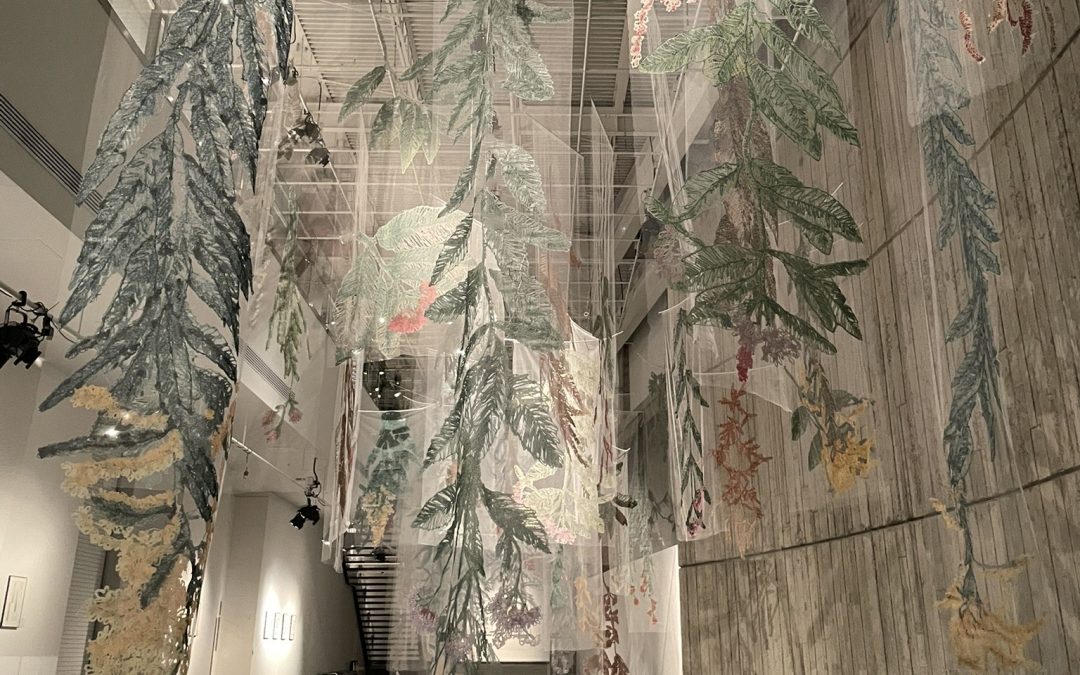
 In September 2026, I travelled to Calgary, Alberta, to install Ode to a Prairie at the Nickle Galleries on the University of Calgary’s campus. It was exciting to reinstall this work in the gallery space, which has towering ceilings and large concrete walls. We were able to install the work so that you can walk through what feels like a field of flowers. Many thanks to Jenelle M. Pasiechnik for curating this exhibition, which features work by Glenna Cardinal, seth cardinal dodginghorse and Dwayne Martineau. This exhibition runs from September 18, 2026 to December 12, 2026. Held. Together. is a group exhibition featuring Glenna Cardinal, seth cardinal dodginghorse, Dwayne Martineau and Amanda McCavour. Plants provide the curatorial point of departure for Held. Together. From this starting point, the exhibition brings together artists whose practices engage differently with questions of relationship, place and belonging. Attending to the ecological intelligence of grassland species, the exhibition considers reciprocity and care as forces that sustain human and more-than-human life. Situated where the Foothills Fescue and Foothills Parkland ecosystems meet, Guts-ists’i, Wîchîspa Oyade, Moh’kinstsis provides the ecological context for the exhibition. These grasslands and waters have known, held and sustained the Tsuut’ina, Stoney Nakoda Nations and the Blackfoot Confederacy since time immemorial. Their enduring relationships with these lands and waters continue to shape understandings of place and community. Beneath the prairie, grasses form intricate networks of roots and relationships that stabilize soil, retain nutrients and create conditions for other forms of life to flourish. Much of this work is unseen, yet it is fundamental to the health and continuity of the ecosystem. Held. Together....
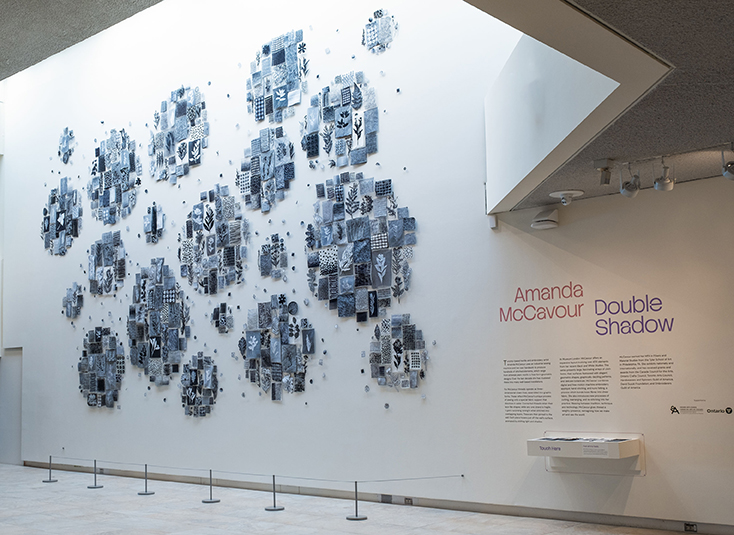 Double Shadow is now on view at Museum London, and this exhibition runs from May 23, 2026 to March 14, 2027. Double Shadow brings together over 500 stitched elements from my Black and White Studies series. Botanical motifs mix with bold geometry across the wall, shifting with the light as you move through the space. Planning Installing a piece like this comes with a little bit of uncertainty and excitement. The Atrium wall at Museum London is so much larger than my studio, so before anything went up in the gallery, I installed part of the work on my living room wall to work out how many pieces I’d need to cover that amount of square footage. My home became a temporary test site, with stitched elements mapped across the space. But no matter how carefully you plan, the first time you actually see the finished installation is when you’re installing it. There’s no way to fully preview 500+ pieces coming together on a wall of that size. The Install The process started with a diagram — mapping out the general arrangement of circles, then scaling that to the dimensions of the Atrium wall so every circle had precise measurements. That diagram was projected directly onto the wall surface, and each circle was marked out with blue tape and labelled with a letter. From there, I divided the 500+ pieces proportionally across each circle. This step mattered a lot — I wanted the botanical motifs, the abstract patterns, the different techniques, and the balance of black and white distributed thoughtfully across the whole wall. Once the pieces were sorted...
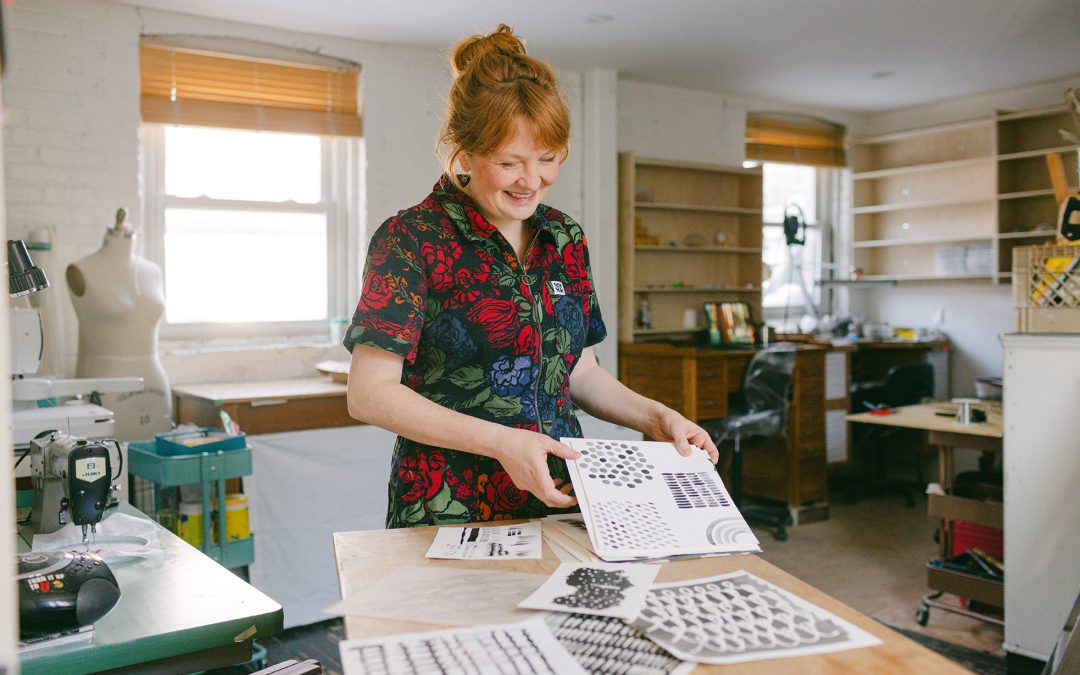 This week, photographer Christine Lim visited my new Toronto studio. She captured a few images of what I’ve been working on. I pulled out some current projects for the shoot: black and white embroidery and nuno felted pieces in progress for an upcoming show at Museum London, plus the watercolours that served as source material for the patterns. I also brought out wire pieces from an upcoming commission, along with a few finished, powder-coated examples. Here’s a peek into the studio space, some works in progress, and a few samples. Take a look at more of Christine’s photography...
 One Sentence Summary: My embroidered installation at Hermès Madison Avenue features Pegasus in Bloom, where the mythical winged horse emerges from a stitched Hermès scarf into a field of flowers. Date: August 2025 I’m excited to share that in June 2025, I installed two new embroidered works at the Hermès Madison Avenue location in New York City. The window installation, Pegasus in Bloom, will be on display through the end of September 2025, alongside an interior piece, Floating Garden, installed in the store’s historic staircase area. Pegasus in Bloom: The Window Installation Pegasus in Bloom is a window installation that tells a story of emergence and lightness—the transition from night to day, winter to spring. At its center, I have enlarged and rendered the Libre Comme Pégase scarf with its bold blues and painterly design entirely in stitch, suspending it mid-air in the Hermès window space. The scarf unfurls like a portal from which the mythical Pegasus emerges, appearing to leap forward in flight. The winged creature arcs through the space in a quiet transition from twilight into daylight, suggesting motion and freedom. Pegasus emerges into a field of embroidered flowers that shift from deep midnight tones to soft spring pastels. The florals—rendered in rich reds, purples, and blues—create a vibrant ground that evokes early spring. Leather bags echo the flowers’ hues in colors that hint at spring’s arrival. Floating Garden: The Interior Installation Within the historic staircase area, Floating Garden creates an idealized space—an imaginary and dreamlike environment. This installation addresses the history of botanical themes in stock embroidery, taking flowers out of the context of embroidery ‘kits’ and moving these images into an installation to create...
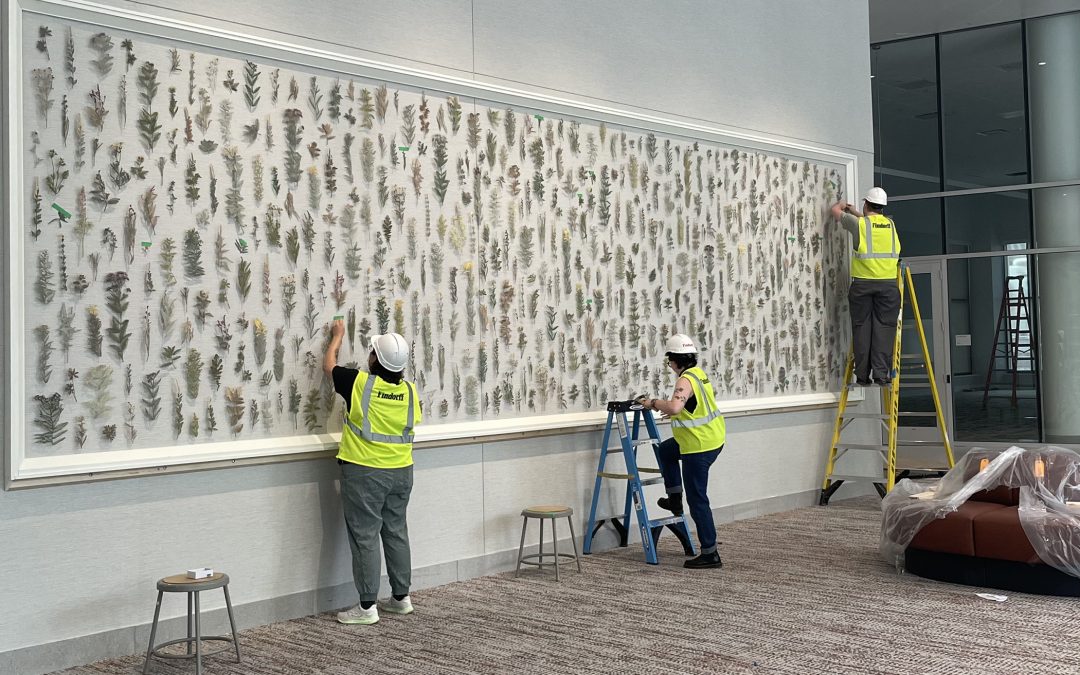 This summer, I traveled to Madison, Wisconsin, to install two large-scale works in the new CDIS (Computer, Data & Information Sciences) building at the University of Wisconsin-Madison. Working alongside an amazing team of students and staff from the CDIS School, I spent several days transforming interior spaces with embroidered botanical forms inspired by Wisconsin’s native prairie plants. We were even able to squeeze in a visit to the Herbarium.I am delighted that the pieces have found a home on the University’s campus. These installations build on work I originally created in 2019, which previously hung in the Chazen Museum of Art. That project began with research visits to two campus collections: the Wisconsin State Herbarium, where I studied preserved botanical specimens, and the Helen Louise Allen Textile Collection. I’ve long been interested in how botanical forms migrate between scientific documentation and decorative traditions—how the same flowers appear on herbarium sheets, in textile patterns, and on wallpaper designs. These collections allowed me to trace those connections through Wisconsin’s indigenous plant species. For the CDIS building, I adapted these two pieces: Prairie Plant Studies is a 25-foot wide installation located near the Orchard Street entrance of Morgridge Hall, across from Hello World Auditorium. This wall of embroideries recreates pressed flowers indigenous to the Wisconsin prairie—goldenrod, milkweed, and other native species I studied at the State Herbarium. Each piece is made using my water-soluble fabric technique: I sew into fabric that dissolves in water, building up stitched lines and crossing threads. When the fabric dissolves, the thread drawings interlock together without any backing, held together purely through their accumulated connections. I love...